# How Common Is Hidradenitis Suppurativa in Germany? Why the Numbers Differ

Canonical URL: https://www.acneinversa.life/en/blog/hs-prevalence-germany/
Markdown URL: https://www.acneinversa.life/en/blog/hs-prevalence-germany.md
Plain text URL: https://www.acneinversa.life/en/blog/hs-prevalence-germany.txt
Language: en
Category: Basics
Published: 2026-10-11
Last updated: 2026-10-11
Last editorially reviewed: 2026-10-11
Next scheduled review: 2027-10-11
Evidence strength: Moderate evidence — Backed by consistent observational studies or smaller trials.
Author: Dr. rer. nat. Dennis Alexander Kwiatkowski (Biochemist, Scientific Writer and Pharma Expert)
Scientific editor: Dr. rer. nat. Dennis Alexander Kwiatkowski
Reviewer qualifications: Biochemist, Scientific Writer and Pharma Expert
Review scope: Scientific literature, clinical guidelines, sources, and editorial clarity
Clinical reviewer: No independent clinical review
Tags: Acne Inversa, Hidradenitis Suppurativa, HS, Basics, prevalence, epidemiology, Germany, statistics, how common is HS, diagnosis

> German studies report HS in 0.03%, 0.3% or 1.16% of people. They measured different things. What each study found, why the figures differ, and what can reasonably be concluded.

Medical disclaimer: This website is for general educational information only and does not replace medical advice, diagnosis, or treatment. Please speak with qualified medical professionals about symptoms or treatment decisions.

## 60-second summary

- German insurance data from 2010 recorded an HS diagnosis in about 0.03% of insured people.
- Skin examinations of 20,112 German employees found HS in about 0.3% — the figure the German treatment guideline cites.
- A small 2024 study in Darmstadt found HS in 1.16% of 519 adults (95% CI 0.53–2.50%).
- A 2025 global meta-analysis of clinically confirmed cases estimated 0.99%; questionnaire-only studies pooled to 2.5%.
- These figures measure different things and cannot be averaged into one German number.

**What this means:** Recorded diagnoses very probably undercount HS. That supports taking recurring painful lumps seriously — it does not mean any one person has HS.

**What we are less certain about:** No nationally representative, clinically confirmed prevalence study for Germany exists. Every German figure comes from a specific group: insured people, employees or hospital visitors in one city.

**What you can do next:** If painful lumps keep returning, document the pattern and have it assessed rather than estimating your own odds from population figures.

## Article

Hidradenitis suppurativa (HS), also called Acne Inversa, is often described as underdiagnosed. But how common is it?

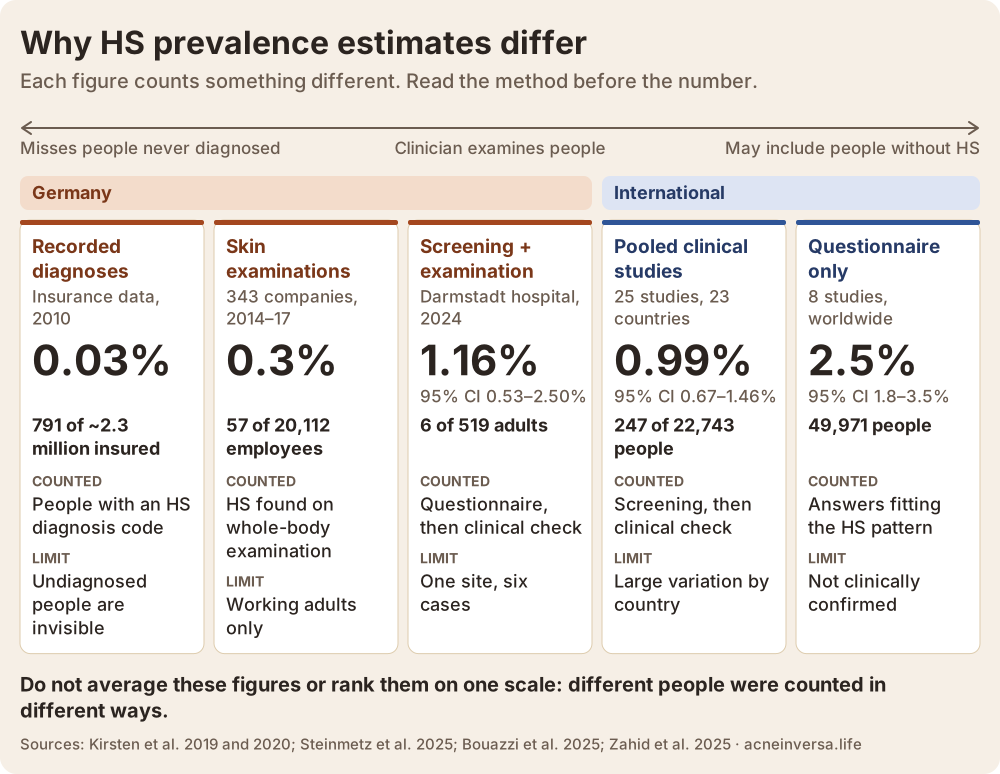
The answer depends heavily on how researchers look for it. In Germany, an insurance-data study found a recorded diagnosis in about **0.03%** of insured people. A study that examined the skin of working adults found **0.3%**. A more recent study in Darmstadt reported **1.16%**. International research puts the figure at around **1%** — or higher, if questionnaires alone are used.

Those numbers look contradictory. They are not measuring the same thing.

This article explains what each study found, why the estimates differ, and what can — and cannot — reasonably be concluded about HS in Germany.

## The central distinction

A **recorded diagnosis** is not the same as a **clinically identified case**, and a **positive screening questionnaire** is not the same as a **confirmed diagnosis**. Most of the apparent contradiction between HS figures disappears once you know which of these three a study counted.

## What does "prevalence" mean?

Prevalence is the proportion of a population living with a condition at a given time. A prevalence of 1% means about one person in every hundred **in the group that was studied**.

That last part matters. A prevalence figure only means something once you know who was studied and how cases were identified. HS researchers use three main methods:

- **Insurance or billing records.** Researchers count people with an HS diagnosis code. This covers millions of people, but it only finds people whose HS has been recognised and coded. Someone with years of recurring "boils" and no HS diagnosis is invisible.
- **Clinical examinations.** Researchers examine participants and decide who meets the study's diagnostic criteria. This finds undiagnosed cases, but the result depends on who agreed to take part.
- **Screening questionnaires.** Participants answer questions about recurring boils or abscesses in typical locations. This also finds undiagnosed cases, but a positive answer is not a confirmed diagnosis — other skin conditions can produce similar symptoms.

## What German studies have found

Three German studies are most useful. They should **not** be averaged: each describes a different population measured a different way.

<table class="compare-table" role="table">
<caption>German HS prevalence studies compared</caption>
<thead role="rowgroup">
<tr role="row">
<th scope="col" role="columnheader">Study</th>
<th scope="col" role="columnheader">Who and how</th>
<th scope="col" role="columnheader">Reported prevalence</th>
<th scope="col" role="columnheader">Main limitation</th>
</tr>
</thead>
<tbody role="rowgroup">
<tr role="row">
<th scope="row" role="rowheader">Kirsten et al. (insurance data, 2010 figures; published 2019)</th>
<td role="cell" data-label="Who and how">Diagnosis codes in a representative sample of about 2.3 million people insured with DAK-Gesundheit; confirmed in Barmer data</td>
<td role="cell" data-label="Reported prevalence">0.03% (791 people with a coded diagnosis)</td>
<td role="cell" data-label="Main limitation">Counts only recorded diagnoses</td>
</tr>
<tr role="row">
<th scope="row" role="rowheader">Kirsten et al. (workplace examinations, 2014–2017; published 2020)</th>
<td role="cell" data-label="Who and how">Whole-body skin examinations of 20,112 employees in 343 German companies</td>
<td role="cell" data-label="Reported prevalence">0.3% (57 people)</td>
<td role="cell" data-label="Main limitation">Working adults only; may underestimate (the "healthy worker effect")</td>
</tr>
<tr role="row">
<th scope="row" role="rowheader">Steinmetz et al. (Darmstadt, 2024; published 2025)</th>
<td role="cell" data-label="Who and how">519 healthy adults accompanying patients at Klinikum Darmstadt; validated questionnaire, then clinical examination</td>
<td role="cell" data-label="Reported prevalence">1.16% (6 people; 95% CI 0.53–2.50%)</td>
<td role="cell" data-label="Main limitation">Small, single-centre sample; only six cases</td>
</tr>
</tbody>
</table>

### The insurance study: 0.03%

Kirsten and colleagues analysed data from two German statutory health insurers and national hospital discharge statistics for 2010 to 2015.

In a representative sample of about 2.3 million people insured with DAK-Gesundheit (out of 5.9 million in total), **791 had an HS diagnosis recorded in 2010** — a *coding prevalence* of about 0.03%. Data from a second insurer, Barmer, covering about 9 million people, gave a consistent result. The authors themselves called the figure "lower than expected".

They also looked at what happened before people were diagnosed. Among people newly coded with HS in 2015, **at least 34.7% had a potential misdiagnosis recorded in 2014**. That does not prove each earlier diagnosis was wrong. It does show that recognition and coding are a real limitation when HS is counted through administrative records.

**What this study shows:** recorded HS diagnoses were uncommon in German insurance data.
**What it does not show:** that only 0.03% of people in Germany actually had HS.

### The workplace study: 0.3%

The same research group then examined people instead of records. Between 2014 and 2017, **20,112 employees in 343 German companies** had whole-body skin examinations. The average age was 43.6 years, and 52.3% were men.

Examiners identified **57 people with HS — 0.3%**. Another 674 people had non-inflammatory skin changes associated with HS; counting those as well gives 3.0%, but that wider figure is *not* the number classified as having HS and should not be quoted as if it were.

The authors noted a key limitation: only people in work were examined. Children, older people and people unable to work — possibly including some with severe HS — were not represented. This "healthy worker effect" could have pushed the estimate down.

The 0.3% figure is also the one the German S2k treatment guideline (2024) gives as the point prevalence of HS in Germany.

**What this study shows:** in these two German studies, examining people found about ten times as much HS as counting diagnosis codes.
**What it does not show:** that 0.3% is the prevalence for the whole German population.

### The Darmstadt study: 1.16%

The most recent German estimate comes from the Klinikum Darmstadt, collected in January and February 2024 as a contribution to the international Global Hidradenitis Suppurativa Atlas (GHiSA).

The study included **519 healthy adults who were accompanying patients** to the hospital. All completed a validated HS screening questionnaire. Everyone who screened positive, plus a random selection of those who screened negative, was then examined clinically.

**Six participants had HS — 1.16%.** The 95% confidence interval runs from **0.53% to 2.50%**. That width is the honest signal here: with six cases, the true figure in a population like this could plausibly be half the headline number or more than twice it.

The participants were also not a random sample of Germany. They were people accompanying patients to one hospital in one city.

**What this study shows:** a screening-plus-examination approach in one German sample found more HS than both earlier German studies.
**What it does not show:** that 1.16% of Germany's population has HS.

## What international research shows

Two meta-analyses published in 2025 put the German figures in context.

### Clinically confirmed cases: about 0.99%

A meta-analysis in *JAMA Dermatology* pooled **25 GHiSA studies from 23 countries on six continents**. All used the same method: population-based sampling, a screening questionnaire, and clinical confirmation of HS. Together they included **22,743 participants and 247 people with HS**.

The pooled prevalence was **0.99% (95% CI 0.67–1.46%)**. But the individual studies differed considerably from one another (I² above 75%), so the pooled number is an average across very different settings, not a figure that applies to every country. The Darmstadt data were collected after the meta-analysis's cut-off, so they are not part of it.

### Questionnaire-only studies: about 2.5%

A second meta-analysis pooled **eight studies with 49,971 participants** that used the same two validated screening questions about recurring boils in typical locations — without clinical examination. The individual studies ranged from 0.7% to 6.4%, and the pooled estimate was **2.5% (95% CI 1.8–3.5%)**.

That is clearly higher than the clinically confirmed estimate. The authors themselves advise caution, citing heterogeneity between studies and sparse data from parts of the world. A questionnaire identifies people whose answers fit a pattern; it does not confirm that each of them has HS.

**The lesson:** a questionnaire-based estimate and a clinically confirmed estimate answer different questions and should not be presented as if they were interchangeable.

## Why do the estimates differ so much?

<figure class="article-infographic">
<picture>
<source media="(min-width: 1200px)" srcset="/images/infographics/hs-prevalence-methods-en-wide.svg" width="1000" height="774" />
<img src="/images/infographics/hs-prevalence-methods-en-tall.svg" width="360" height="2329" loading="lazy" decoding="async" alt="Comparison of hidradenitis suppurativa prevalence estimates from German insurance records (0.03%), occupational examinations (0.3%), a Darmstadt clinical study (1.16%), pooled international clinical studies (0.99%) and questionnaire-only studies (2.5%), showing that different methods produce different estimates." />
</picture>
<figcaption>Why HS prevalence estimates differ: each figure with who was counted and how. The same figures, with sources, are given in the text of this article. <a href="/images/infographics/hs-prevalence-methods-en-wide.svg">Open the full-size infographic</a>.</figcaption>
</figure>

There is no single explanation. Several factors stack up:

1. **Recorded diagnoses miss people.** Insurance data only count people whose HS was recognised and coded. Given how often HS is first labelled as boils, abscesses or infected cysts, undercounting is expected.
2. **Screening finds more possible cases.** Questionnaires pick up people with a typical symptom pattern who were never diagnosed — but also some people whose symptoms have another cause.
3. **Study populations differ.** Employees, hospital visitors and national samples differ in age, sex, weight, health and healthcare access. Each of these can shift the result.
4. **Case definitions differ.** A diagnosis code, a questionnaire answer and an examiner's judgement are three different thresholds.
5. **Small studies are imprecise.** Six cases among 519 people is informative, but it carries a wide confidence interval. Headline percentages should always be read alongside sample size and confidence interval.

## So how many people in Germany have HS?

**Nobody can currently say precisely.** There is no nationally representative, clinically confirmed prevalence study for Germany.

What the evidence supports:

- Counting diagnosis codes alone almost certainly **underestimates** HS in Germany.
- Studies that examine people consistently find **more** HS than the coding data — 0.3% among employees, 1.16% in a small Darmstadt sample.
- International clinically confirmed data point to **around 1%** on average, with wide variation between countries.

What the evidence does **not** support: picking the highest figure and multiplying it by Germany's population to produce a "number of Germans with HS". That would combine the least precise or least comparable estimate with a population it was never measured in. A credible national figure would need representative sampling, a consistent case definition and a transparent confidence interval.

Until such a study exists, the honest answer is a range — with its methods explained — rather than a single precise number.

## Is HS a rare disease?

That depends on the definition and on which estimate you use.

In the European Union, a condition is considered rare for orphan-drug purposes when it affects **no more than 5 in 10,000 people — 0.05%**.

The 2010 insurance coding figure of 0.03% falls below that threshold. The German examination studies (0.3% and 1.16%) and the pooled international estimate (0.99%) are all far above it. A low *recorded* diagnosis rate is not evidence that the disease itself is rare — and that is exactly why the difference between coding prevalence and true prevalence matters.

## What this means if you have recurring symptoms

Population prevalence cannot tell you whether you have HS. A condition that affects around 1% of people can still be hard to recognise in one person, and recurring painful lumps do not automatically mean HS — several conditions can look similar.

More useful questions are:

- Do painful lumps or abscesses keep returning?
- Do they appear in the same kinds of places — armpits, groin, genital or perianal area, buttocks, under the breasts?
- Have they recurred over months or years?
- Are there draining areas, tunnels under the skin or scars?
- What have clinicians previously called them, and what treatment did you receive?

These observations help a clinician assess the pattern. To see how HS can look across body areas and skin tones, use the [HS Visual Guide](/en/what-hs-can-look-like/). For how a diagnosis is actually made, see [How HS is diagnosed](/en/blog/hidradenitis-suppurativa-diagnosis-what-to-expect/), and for why it so often takes years, [why HS is often recognised late](/en/blog/why-hidradenitis-suppurativa-is-often-diagnosed-late/).

**The practical next step is not to calculate your personal probability from population statistics. It is to document the recurring pattern and discuss it with a qualified clinician.**

## Prepare for your next appointment

If you have had recurring painful lumps, drainage or scarring without a clear diagnosis, the free Could This Be HS? Appointment Pack helps you organise previous episodes, locations, labels and treatments into a concise summary for a clinician. It does not calculate a diagnosis, and no account is required.

[Prepare my appointment summary →](/en/possible-hs-appointment-pack/)

## The bottom line

HS is very probably more common than German insurance records alone suggest. But the available evidence does not establish one precise prevalence figure for Germany.

The gap between 0.03%, 0.3%, 1.16% and the international estimates of about 1% or higher is best understood by looking at how each study found its cases and whom it studied. The most useful conclusion is not that one number is right and the others are wrong. It is that **how we look for HS strongly influences how many cases we find**.

For patients, that is a reason to have recurring symptoms properly assessed — not to rely on assumptions about how common or uncommon the condition is.

## FAQ

### How many people in Germany have HS?

Nobody can say precisely, because no nationally representative study with clinical confirmation exists for Germany. Insurance data recorded a diagnosis in about 0.03% of people in 2010; studies that examined people found 0.3% among employees and 1.16% in a small Darmstadt sample. Multiplying any one of these by Germany's population does not produce a reliable national count.

### Is hidradenitis suppurativa rare in Germany?

Published German estimates vary widely. An insurance-data analysis found a recorded diagnosis prevalence of 0.03% in 2010, while studies that examined people found 0.3% (employees) and 1.16% (a small sample in Darmstadt). Those methods are not directly comparable, and no single figure establishes the current national prevalence. The examination studies are well above the EU rare-disease threshold of 0.05%.

### Does HS affect about 1% of people?

A 2025 international meta-analysis of 25 studies in 23 countries, all using clinical confirmation, estimated a pooled prevalence of 0.99% (95% CI 0.67–1.46%). The studies varied considerably, and the figure is a global estimate. It should not be read as the exact prevalence in Germany.

### Why do some websites say HS affects 1–4% of people?

Broad ranges like this usually mix estimates from different study designs, including questionnaire-only surveys, which tend to produce higher figures than studies that confirm cases clinically. A quoted range is only meaningful alongside the studies and methods behind it.

### Is HS becoming more common?

The studies discussed here cannot show that. They used different methods in different groups at different times, so the rising numbers from 2010 to 2024 reflect how researchers looked for HS, not a demonstrated increase in how often it occurs.

### Does a higher prevalence estimate mean more people are being diagnosed?

No. Examination and screening studies find people who may never have received a diagnosis. They say nothing about how many diagnoses are made in routine care.

### Can prevalence statistics tell me whether I have HS?

No. Prevalence describes how often a condition occurs in a group. Whether your symptoms are HS depends on an individual clinical assessment of the lesions, where they occur, how often they return and what else could explain them.

## References

1. Kirsten N, Petersen J, Hagenström K, Augustin M. Epidemiology of hidradenitis suppurativa in Germany – an observational cohort study based on a multisource approach. - Journal of the European Academy of Dermatology and Venereology 2020;34(1):174–179 (online 2019) - https://doi.org/10.1111/jdv.15940
2. Kirsten N, Zander N, Augustin M. Prevalence and cutaneous comorbidities of hidradenitis suppurativa in the German working population. - Archives of Dermatological Research 2021;313(2):95–99 (online 2020) - https://doi.org/10.1007/s00403-020-02065-2
3. Steinmetz MI, Bouazzi D, Kovács M, Medianfar CE, Christensen R, Jemec GBE, Podda M. Prevalence of Hidradenitis Suppurativa in Darmstadt, Germany: A Contribution to the Global Hidradenitis Suppurativa Atlas. - Dermatology 2025;241(Suppl. 1):46–51 - https://doi.org/10.1159/000539285
4. Bouazzi D, Nielsen SM, Hagan PG, et al. Prevalence of Hidradenitis Suppurativa: A Meta-Analysis of Global Hidradenitis Suppurativa Atlas Studies. - JAMA Dermatology 2025;161(10):1022–1028 - https://doi.org/10.1001/jamadermatol.2025.2373
5. Zahid JA, Henning MAS, Bouazzi D, Jemec GBE. Questionnaire-Based Global Prevalence of Hidradenitis Suppurativa: A Systematic Review and Meta-Analysis. - Dermatology 2025;241(Suppl. 1):149–158 - https://doi.org/10.1159/000537920
6. Zouboulis CC, Bechara FG, Fritz K, et al. S2k guideline for the treatment of hidradenitis suppurativa / acne inversa – Short version. - Journal der Deutschen Dermatologischen Gesellschaft 2024;22(6):868–889 - https://doi.org/10.1111/ddg.15412
7. Regulation (EC) No 141/2000 of the European Parliament and of the Council on orphan medicinal products (prevalence criterion: not more than 5 in 10,000). - Official Journal of the European Communities, 2000 - https://eur-lex.europa.eu/eli/reg/2000/141/oj